
Social Media Marketing in Japan: Top Tips (2026)

The plan I get sent most often for Japan has five platform logos across the top and the same asset under each one. When I ask what X is for in that plan, and what YouTube is for, the honest answer is usually “reach.” That answer is where Japan campaigns go quiet.
The apps look familiar. Instagram, YouTube, X, TikTok and Facebook are all here, and LINE sits on nearly every phone. What is different is the job each one does, and how little of the persuading the brand’s own account is expected to do. Japanese users open social media to check whether a product is real, to see who else is using it, and to take part in something. The brands that do well here are rarely the ones posting the most. They are the ones that give each platform a distinct job and then arrange for other people to do the talking.
Below are the five questions I ask when a Japan social plan lands on my desk, with the 2026 campaigns that show what a good answer looks like.
Social Media Marketing in Japan: Top Tips (2026)
1. Does every platform have a different job?
Start with the split. Facebook still carries professional credibility and B2B in Japan. Instagram and YouTube are where discovery and familiarity happen. X is for real-time conversation and participation, and it is unusually strong here: roughly 68 million users, which makes Japan its second-largest market in the world (Source: X Japan via Web担当者Forum, May 2025). LINE is the channel people expect a brand to talk to them on directly. If the plan gives all five the same asset, it has given none of them a job.
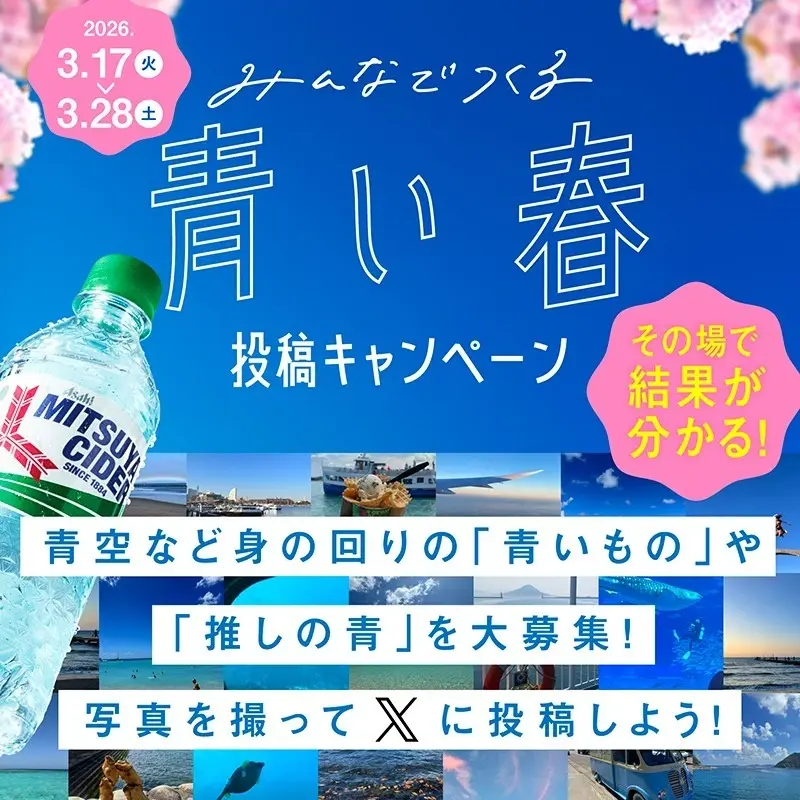
Asahi Beverage’s Mitsuya Cider work this spring is the cleanest example I have seen of platforms being assigned rather than duplicated. The umbrella campaign, 青空を飲んでゆけ (“Drink up the blue sky”), runs from March to August, with must-buy receipt entries handled through LINE and prizes running from Coleman outdoor gear to SUPER BEAVER concert tickets. X was given a different, shorter task. For eleven days in March, users followed @asahiinryo_jp, mentioned the account, and posted a photo of something blue near them under みんなでつくる青い春. 32,800 winners received 100 yen of digital points.
That winner count is not random. March 28 is 三ツ矢の日, Mitsuya Day, and 3-2-8 reads as mi-tsu-ya in Japanese number wordplay; the prize count is the date. No global team would think to do that, and every Japanese user reads it instantly. It cost Asahi about ¥3.3 million in points to fill X with blue photos for a week, which tells you the mechanic was built on participation rather than prize value.
Look at what each platform was asked to do. LINE did the transactional work: receipts, entries, winner notifications. X did the visible work: a feed full of blue objects carrying the brand’s hashtag, timed to a free sampling day in eight cities. Neither channel was asked to do the other’s job.
The fit assessment on hashtag-photo mechanics is that they buy breadth cheaply and depth rarely. Japan has a large community of 懸賞 (prize-draw) accounts that enter everything, so a share of those blue photos came from people who will never buy a cider. That is fine when the goal is a visible wave on a single day, which it was; I would not run the same mechanic to build a following. One line worth copying from Asahi’s terms: entrants agree their photos may be reused on the brand’s site and in its advertising. Write that into your own mechanics before launch, not after.

Kao’s IROKA did the YouTube version in July. The premium fabric softener signed four talents from the VTuber agency Nijisanji (Ibrahim, Kaisei, Fuyuki Hakase and Furen E. Lustario), released a web commercial on July 9, then announced the actual campaign in a live stream on July 16: a limited collab bottle via receipt entry, digital wallpapers with handwritten messages, and out-of-home in Tokyo. The stream did not run on Kao’s channel. It ran on Ibrahim’s, at 8pm on a Thursday, which is when and where that fandom already gathers. YouTube became an event rather than a second home for the ad.
A fabric softener and a VTuber group is exactly the kind of category crossing I keep recommending. The trade-off is ownership: the moment lives on the talent’s channel, so the brand collects fandom heat rather than subscribers. Decide which of the two you are buying before you sign.
The question I ask of every channel is what it can do that the others cannot. When each one has an answer, the campaign reads as native. When they all have the same answer, it reads as imported.
2. Is the idea Japanese, or only the copy?
Translation is where most localisation stops, and it is where most Japanese audiences stop reading. A perfectly rendered Japanese headline on a campaign shot in a European studio still looks like a campaign that happened to somebody else.
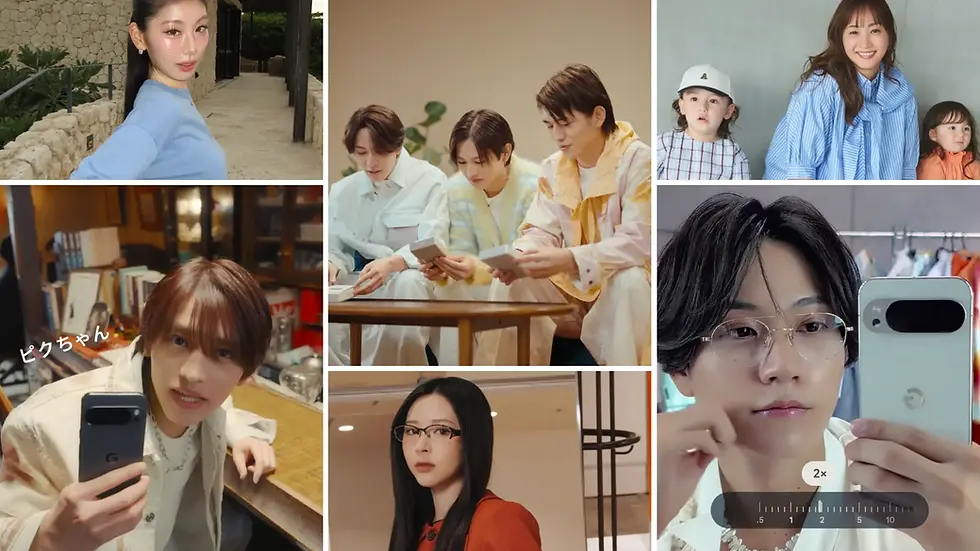
Google's Pixel work in Japan is the case I now use to explain what the alternative looks like. In February, Google put three members of Timelesz, the idol group formerly known as Sexy Zone, into three 15-second Pixel 10 spots: Masaki Hashimoto, Shuto Inomata and Daiki Shinozuka. All three joined the group through the 2025 audition, so they are its newest faces, and Google built the campaign on that fact. It runs under the banner of 新生活, shinseikatsu, the "new life" season that begins every April when Japanese schools and companies reset. Every brand in Japan plans around shinseikatsu. Very few global ones do, because their own launch calendar says August.

The spots explain global features through Japanese daily life rather than through a spec sheet. Hashimoto uses Super Res Zoom Pro from a magazine-shoot dressing room to photograph his own billboard through the window. Inomata sits in a kissaten, points the phone at a photo of the writer Miyazawa Kenji on the counter and asks Gemini to explain him as a four-panel manga. Shinozuka, who appears on TV quiz shows in real life, drills for one with Gemini. A dressing room, a kissaten, a 4-koma, a quiz show: each is a setting a Japanese viewer reads without explanation, and each carries a feature a global brief would have listed as a bullet point.
The honest limit is that talent-led localisation needs somebody who can read the room. Google could tie a global handset to the newest members of an idol group because someone on the Japan side understood the audition, the fandom's etiquette and the spring calendar well enough to build a five-month sequence around them. A team choosing a Japanese celebrity from a list of follower counts gets the face without the story. The test I use in creative review is simple: would a Japanese viewer nod or wince? I learned that test over twelve years in Seoul and it transfers to Tokyo without edits. If nobody on the team can answer it, the creative is not ready, whatever the translation quality.
3. Who is doing the convincing?
Japanese consumers are careful with unfamiliar brands, and they do their checking in public. Before a first purchase they want to see the product inside someone’s actual routine, and they want that someone to be a person they already follow. The brand’s own claims are a starting point, rarely the deciding one. A social plan that pushes straight to purchase skips the step Japanese buyers refuse to skip.

KOPHER, a Korean skincare brand building its Japan presence, is a good example of a brand letting somebody else talk. Beauty creator Hausdust (@tamukun_36) featured it on TikTok this year as the product she reaches for when her skin is acting up. The video is structured as her routine with a problem in it, and KOPHER appears as the fix rather than as a list of benefits. The comments I read for on a video like this are the ones asking where to buy and which variant to pick; those are the signals that trust has moved from the creator to the product. On TikTok I would also watch the saves count before the view count, because a save is a note-to-self to buy.

The same structure works outside beauty. Michi (@mi0306chi), who appears in JINS’s visual campaign, posted from the opening of JINS Shinjuku while styling her favourite half-rim frames, which turns a store opening into a personal styling post. Cooking creator Ryuji, one of the most followed food creators in the country, showed how to make 味付け卵, seasoned eggs, with a single Mizkan seasoning. In both cases the product sits inside something the creator already does every week. People watching Ryuji came for dinner, and the seasoning is part of dinner.
What you give up is the script. Recommendation content converts because the creator sounds like themselves, and that means the brand’s key message arrives in the creator’s words or not at all. A team that needs every claim approved verbatim will find this format frustrating. Two things I would insist on instead: the disclosure is clear, since Japan’s stealth-marketing rules have had teeth since October 2023, and the creator has used the product long enough to hold an opinion about it.
4. Does the creator already make this kind of content?
Creator work in Japan has moved past product placement. The recommendation lands when the audience already follows the creator for the category, so my first filter is the creator’s existing feed. Follower count comes later.

Monako is the example I use with international brands. In 2026 the Japanese fashion creator worked with Herno and Diesel, and the sponsored posts sit inside her feed as if they had always been there, because her feed is strong among fashion content. Her audience is also mostly in Japan, which matters more than it sounds. Plenty of large Japan-based creators have a follower base that is half overseas, which is wonderful for a brand’s global numbers and useless for a Japan launch.

Two more from this year show the principle with less obvious pairings. Petit main, the kidswear brand from Narumiya, marked its 15th anniversary with a four-piece collection designed with Miki Fujimoto, the singer and TV talent every Japanese parent knows as Mikity, and built the whole thing openly around her point of view as a mother of three. The collection launched on June 19 with each piece carrying a “Mikity’s point” note on what she changed and why. Raia’s collaboration with OTO MART turned a sound experience event into an ASMR vlog, which is the format her audience already comes to her for. In both cases the creator’s existing identity decided the format. The brand did not hand over a template.
So the order I check in is: content fit, then where the audience actually lives, then the creator’s usual format, and only then follower count. A mid-sized beauty creator who talks about styling every week is a better door into fashion than a much bigger creator whose audience has no reason to care.
The cost is a reach ceiling. Category-native creators are usually smaller than general-entertainment creators, so a launch built only on fit can be right and quiet. I pair them with a reach layer, one bigger name for the announcement moment, and let the fit layer do the convincing.
5. Where does the relationship go after the post?
LINE is on the phones of 100 million people in Japan, roughly eight in ten residents. It is where a campaign is supposed to continue. The mistake I see is treating it as a broadcast list that fires a coupon every few weeks, while the social campaign that brought people in has already moved on to

Starbucks is the global brand that has done this best in Japan, and the design choice that makes it work is one most international teams would argue against. Starbucks already had a native app, a prepaid card and an 18 million-member rewards programme. In 2019 it put a second version of the card inside LINE anyway, as a mini-app, so that a customer could become a member, top up, and pay without downloading anything. Order & Pay followed in December 2021, with the "your drink is ready" notification arriving as a LINE message. The plan was to let that person start in LINE and move to the native app as their visits increased.
By October 2025, 4.4 million people held a LINE Starbucks Card, about a quarter of all rewards members, which is far too many to be a coupon list. Around 40% of them had gone on to link a My Starbucks account, the step you only take when you want to redeem your Stars, so the ladder from light to loyal is visibly working. The mini-app also became the test bed: PayPay top-up launched in LINE first, customers liked it, and Starbucks brought it to the main card in May 2024.
The other half of the LINE story is gifting. A Starbucks drink ticket sent through LINE Gift is now the default プチギフト, the small thank-you or birthday gesture, in Japan, and the brand runs it as a growth mechanic: in the 2026 Gift1 Get1 waves, anyone who sent a ¥3,000 book of eGifts to a friend received a ¥500 ticket themselves, capped at the first 100,000 to 150,000 senders (Source: LINE Gift, April and August 2026). Every one of those gifts is a new person receiving a Starbucks ticket inside a chat with someone they know, which is a warmer first encounter than any ad.
CONCLUSION
If you brought me a Japan social plan tomorrow, this is roughly what I would say in the room.
Show me the job for each platform, one line each, and show me they are different. Show me the idea, and tell me whether a Japanese colleague would recognise it as theirs. Show me who is going to say the product is good, because it should not be you. Show me the creator’s last twenty posts before you show me their follower count. And show me where a person goes after they like the post, because if the answer is nowhere, the campaign ends the moment it starts.
Japan does not reward the brand that talks the most. It rewards the brand that arranges for other people to talk, and then keeps the conversation going. Relevance first, reach second, and a LINE account ready before the first post goes live.
Frequently Asked Questions
Which social media platforms matter most for marketing in Japan?
Each platform does a different job. Facebook carries professional credibility and B2B, Instagram and YouTube handle discovery and familiarity, X drives real-time conversation and participation, and LINE is the channel where people expect brands to talk to them directly. A plan that gives all five the same asset has given none of them a job.
Why is X (Twitter) so effective for campaigns in Japan?
Japan is X's second-largest market in the world, with roughly 68 million users, and it rewards participation mechanics. Asahi's Mitsuya Cider campaign filled X with user photos of blue objects under a branded hashtag for eleven days, rewarding 32,800 winners — a number that reads as "Mitsuya" in Japanese wordplay — with small digital point prizes.
What does localisation mean in Japan beyond translation?
The idea itself should be Japanese, not just the copy. Google's Pixel campaign put three newly joined timelesz members into spots built around shinseikatsu, Japan's April "new life" season, explaining global AI features through a kissaten, a four-panel manga and quiz-show prep. The test: would a Japanese viewer nod or wince?
How should brands choose influencers in Japan?
Check in this order: content fit, where the audience actually lives, the creator's usual format, and only then follower count. A creator whose feed already covers the category converts better than a bigger name whose audience has no reason to care. Because category-native creators are usually smaller, pair them with one bigger name for the announcement moment.
How do brands use LINE for marketing beyond sending coupons?
As the place the relationship continues. Starbucks put a full membership card inside LINE as a mini-app — join, top up, order and pay without downloading anything. By October 2025, 4.4 million people held a LINE Starbucks Card, about a quarter of all rewards members, and around 40% went on to link a My Starbucks account.


