
Japan TikTok Influencers: Rising in 2027

Updated: 11 minutes ago

Japan has 39.2 million TikTok users, up 15% year on year, and the market has grown its own shorthand for what brands want from them: TikTok売れ (TikTok-ure, literally "sold because of TikTok"). Most brands hear that phrase and brief it head-on. Get the product in front of as many people as possible, then wait for the sales line to move. After enough creator work in this market I read it the other way round. TikTok-ure is a comment-section event before it is a sales event. The sale shows up when the comments stop being about the creator and start being about the thing in the creator’s hand. Nearly every video below was chosen because you can watch that shift happen, or watch it fail to happen, in real time.
This list is not ordered by follower count. A 40K-follower video tutor sits between a dentist and a late-night snack creator on purpose, because the lesson in each case is the mechanics of the video, not the size of the room.
20 Best TikTok Influencers in Japan
1. Bayashi
Followers: 55M

Hiroaki Nakabayashi is the one creator on this list whose audience is mostly outside Japan. The format that built the account, oversized portions going into a deep fryer with crisp ASMR sound and that grin at the end, travels without subtitles. That is how a chef from Japan ends up with 55 million followers, and why a domestic brand that books him gets a scale no other Japanese creator can offer.
The Yamachan video is not a cooking video at all. It is a round of janken with fellow creator SATOYU for the chain’s signature "phantom wings," shot as the bit it is, with the food as the prize rather than the subject. For a regional restaurant chain, 740K views is a remarkable number, and the comedy format is what made it possible. Nobody is being sold to; they are watching two friends compete for wings, and the brand name is in the prize.
What Yamachan bought is a format memory. The chain is now "the janken video" to a very large number of people, which is exactly what a dine-in brand wants before the next trip to Nagoya. Bayashi’s real gift to a brand is that he can make the product the centre of a game without making the video feel like work.
2. しゅん (Oshima Shun)
Followers: 11.2M

Shun is one half of the Oshima siblings (おおしま兄妹), and the format the account runs on is the transformation cut: deliberately scruffy in frame one, idol-polished in frame two, with his sister Sakura usually somewhere in the joke. Daily-routine clips and music covers fill the gaps. Gen Z reach is the reason brands call.
Christian Louboutin had him unbox a selection of shoes, and the unboxing stays inside his register: genuine reactions, his usual warmth, a luxury house suddenly sitting in a Gen Z feed without looking out of place. At 91K views the comments are full of affection for Shun, and that is the point of the booking. A heritage brand borrowed a face its next generation of customers already love, and he made the shoes feel like something a 20-year-old could want.
3. 景井 ひな (Kagei Hina)
Followers: 10.9M

Kumamoto-born Kagei Hina became Japan’s most-followed female TikToker within a year of starting and has since crossed over into television and acting. What keeps her useful to brands is that the account never went corporate: meme series, vlogs, makeup and fashion transformations, and a habit of talking openly about hard stretches in her own life. Mainstream talent with a casual feed is a rare combination in Japan.
The embedded video is a walkthrough of Dr. Simi’s "Happy Theme Park" pop-up in Shibuya, a brand that started life as a Mexican pharmacy mascot. She moves through the games and activities; there is no claim to make, only a space to show. That is why a mainstream talent is the right vehicle for an experiential launch. At 159K views the comment section did something worth noting: viewers from Mexico turned up alongside the Japanese audience. When an overseas brand enters Japan with a local face, the home-market fans arrive in the comments, and Japanese viewers read that as proof the thing is real.
4. Nonochi (ののち)
Followers: 590K
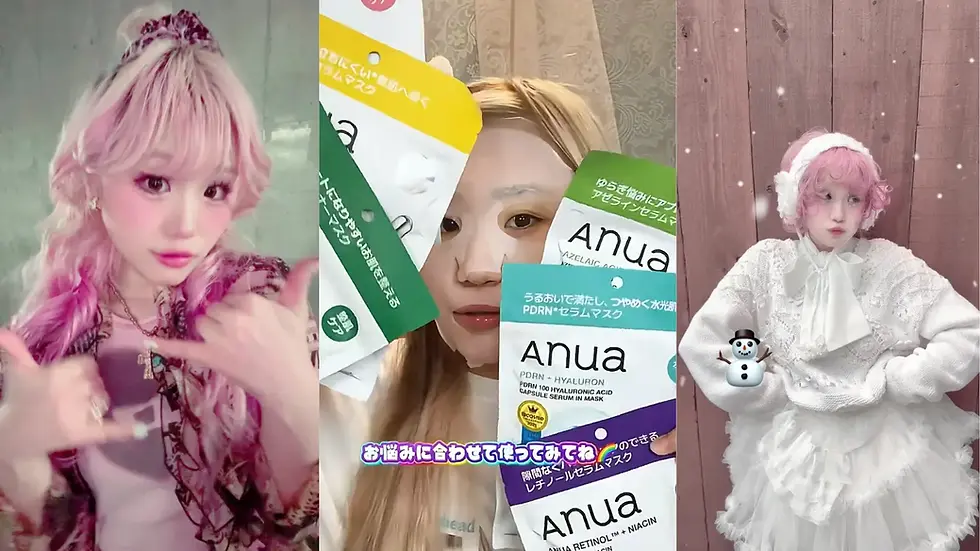
Nonochi works the Harajuku end of beauty: makeup transformations, self-acceptance content, family vlogs, and recently a debut as vocalist of a three-piece band. The persona is down-to-earth, and she talks about her own insecurities often enough that her audience treats her recommendations as coming from someone who needed them.
Her Anua video has a structure I would copy for any K-beauty entry into Japan. She picks the product up at the brand’s experiential booth, then the video cuts to her bathroom and she uses it inside her real routine. The booth gives her a reason to be holding it; the routine gives the viewer a reason to buy it. At 58K views the comments split between compliments and questions about the routine, and the routine questions are the ones that tell you the product landed.
5. myruk0
Followers: 1.8M

myruk0 films Kyushu and the surrounding regions on a smartphone and edits them to look like a Ghibli establishing shot: empty platforms, old town streets, late light. The feeling he is selling is natsukashii, the ache for a place you may never have actually been to. He is selective about commercial work, which is part of why his audience believes every frame. The example here is an organic post about the koinagashi carp-streamer event on the Saba River in Yamaguchi.
It did 1.5M views, and the comments are people asking when it is on and how to get there. That is destination intent, the rarest comment type on this entire list, and a tourism board could not have scripted it. The brief for a creator like this is short: film it your way, tell them the dates. Give him that room and a tourism board gets the most convincing destination content on this list.
6. Hiyorimaru
Followers: 900K

Hiyorimaru is a gaming streamer who turned the opposite direction from the loud end of the category. Pastel setup, quiet keyboard sounds, a cozy-gamer persona built for the "kawaiicore" audience. The desk is the content as much as the game is.
UGREEN used that desk. The video shows its Honkai: Star Rail collaboration accessories sitting in her blue setup, and the product is there to be photographed in context, not explained. The comments are what the brand paid for: people asking what the gear is and saying they want to try the game. For a peripherals brand with a collab edition, aesthetic match is the whole brief, and the view count is the least useful number on the screen.
7. Omi Kim
Followers: 580K

Omi Kim photographs Osaka at night and cuts it to lo-fi. He has a published photo book, "Osaka Romantics," and the TikTok feed has the same premium, slightly melancholy register. The embedded video is Dotonbori in the rain, and it shows why he belongs on a brand shortlist: the feed is a template for what premium city content looks like in Japan right now.
At 116K views the comments are all "I want to go." For a hotel, an airline, or a camera brand, he is a location-first buy, and the best brief is the simplest: make the product the thing he films with or the place he walks to, and let him do the rest.
8. Hiro Odagiri
Followers: 560K

Hiro Odagiri is a working celebrity hair and makeup artist who reviews beauty products without a filter and with a theatrical vocabulary that his audience quotes back at him. That independence is the asset: his audience knows he would say so if a product did not work, which is why his recommendations carry weight.
KATE sent him the newest pencil in its eyebrow line. He builds feather brows on camera, explains what the pencil is doing as he goes, and the tutorial carries the product claims without anyone reading them out. 203K views, and the comments include people saying they have already tried it. An expert known for honest reviews is the one whose "yes" converts, and KATE got a yes.
9. Son Ami
Followers: 620K

Son Ami is Japanese-Korean, lives in Seoul, and her feed is Olive Young hauls and step-by-step Korean makeup for a Japanese audience. Her line is 一緒に可愛くなろう, "let’s get cute together," and she plays the older sister who already tried everything so you do not have to.
That makes her close to ideal for Korean brands entering Japan, because her audience has already self-selected for K-beauty and trusts her to filter it. Manyo put its glutathione line into her routine, and the video did 804K views, the biggest number in the beauty cluster on this list. The comments are compliments and routine questions in roughly equal measure. The routine questions are the signal, and they show up because she puts the product in sequence inside her real routine rather than holding it up to camera.
10. Urchin 志
Followers: 145K

Urchin is a dentist who posts luxury travel, lookbooks, and family life, and the profession does real work for the persona: the audience reads her as someone with a career first and a feed second. Her Shein swimwear try-on did 74K views with a warm comment section, and for a fashion brand that is the value: an audience that already trusts her taste watching her wear the product. Book her for credibility by association, which she has more of than most accounts three times her size.
11. Shinya
Followers: 40K

The smallest account on the list, and one of the easiest briefs. Shinya teaches short-form production: how to shoot, how to cut, how to make a Reel that stops a thumb, with a course behind the free lessons. His audience is made of people who are about to buy equipment.
DJI gave him its mini mic and he folded it into a normal tutorial, demonstrating the noise cancellation on his own voice mid-lesson. 11K views, every one of them from someone in the market for equipment. For a tool brand that is a more valuable audience than a million lifestyle views. Small teacher, purchasing audience. I would want him on any hardware launch in Japan.
12. Richi
Followers: 590K

Richi calls herself a confectionery otaku and dresses the part in pastel-pink Harajuku style. The feed is yashoku, late-night snacks, candy ASMR, convenience-store explorations, and recreations of viral sweets from scratch. She also works at BABY TAPI TOKYO, which gives her a street-level view of what is selling in Harajuku before the trend reports catch up.
For Godiva’s seasonal Chocolixir she did what she does every night: tasted it on camera, described the flavour in detail, and showed which chocolates pair with it. That pairing detail is the difference between a review and a promotion. 139K views, and the comments are people saying they want to try it. Seasonal menu launches belong with creators whose job is describing taste.
13. Yura Neko (ゆら猫)
Followers: 1.6M

Yura Neko is black-and-green from hair to keyboard, a cyberpunk-meets-cat-culture gamer who mixes dance, cosplay, and gameplay for a Gen Z audience that treats her as a fandom, not a feed. That distinction is the whole entry.
Nescafé ran a drink-mixer competition and she entered it. The video is her building her own coffee drink, then asking fans to vote for her so she can host the brand’s fan appreciation event. 149K views, and the comments are people reporting that they voted again today. Give a creator with a fandom something to win and the fandom does the daily work for you. That is a mechanic, not a message, and it is the best use of a fandom-led creator on this list.
14. Maipan
Followers: 1M

Maipan is a certified cosmetics expert who mostly posts comedy. Her skits are あるある (aruaru, the "that is so true" genre) about friendships, school, and the small social negotiations of being young in Japan, with beauty content threaded through. The expertise is real; the tone never lets it get in the way.
The Je l’aime video is the best-constructed piece of branded content on this list. The skit is about hanging out with a new boyfriend. The joke resolves on her hair holding up through the day, and the hair product is the reason the story ends the way it does. 2.2M views, and the comment section does two things at once that rarely happen together: people quote their favourite lines from the skit, and people say they want the product. Both signals, same video.
The lesson is structural. A product placed in a skit is a prop. A product that resolves the skit is the plot. Brief for the second and the comments will tell you whether you got it.
15. Hinata
Followers: 1.3M

Hinata’s motto is 面白いはいつも日常に, "the funny is always in the everyday," and the feed is exaggerated skits about ordinary situations delivered at speed, with the kind of rapid monologue that hooks in the first second. She has been doing it across platforms for years.
Adobe gave her Photoshop and she turned a software demo into a sketch: editing herself into an astronaut, surrounding herself with marine animals, playing the results for laughs. 4.4M views and 72.9K likes for what is, underneath, a software demonstration. That is the reach a trial funnel wants, and she got it by making the outcome the joke, which is the way a software demo thrives on TikTok.
16. Raia
Followers: 370K

Raia is a fixture of the tenshi kaiwai (angel-core) scene: soft-spoken ASMR, toy unboxings, cozy daily vlogs, a persona that is gentle with a little mischief in it.
Candy A Go Go put her in its sour gummy challenge and she ran it as a product test in her usual style, one gummy at a time, sound first. 90K views. The comments split between praise for the audio and curiosity about the gummies, and for confectionery the second half is the part you want. The sensory format does the selling on its own; the brief is to not interrupt it.
17. House Dust (ハウスダスト)
Followers: 1.5M

House Dust built an audience on one line, "insecurities can become weapons," and a feed of dramatic transformations and anime-inspired looks that show the work rather than the result. Her reviews are treated as honest inside her community because she shows her own unfiltered starting point every time.
The Hana by Hince video is a lip demonstration: how she gets the shape and the colour she wants with the product, step by step. 2.4M views, and the comments are about technique, people saying they are impressed by how she got the shape and that her method makes their own makeup photograph better. Technique comments are trust transfer in its purest form. The viewer walks away with something, and praise for the creator is incidental. The product rides on the technique, which is why a transformation-credentialed creator is worth more to a makeup brand than a face-forward one with twice the followers.
18. Shinako
Followers: 1.5M

Shinako is a Harajuku subculture figure whose feed runs on brightly coloured desserts, dance challenges, and alternative makeup, under the motto 好きにまっすぐなPrincess, "the princess who stays true to what she loves." Younger audiences follow her for permission to want things loudly.
Universal Studios Japan used that for the fifth anniversary of Super Nintendo World. She walks the park, reacts, and tells people to go. 102K views, and the comments are viewers saying they want to try it themselves. For a theme park that is the only comment type that matters, and it shows up because the video is her day out, not a list of attractions.
19. Mew Amane
Followers: 905K

Amane is a Nagano-born actress and gamer whose TikTok is cozy slice-of-life, relationship skits, and travel, performed with more effort than the genre usually gets. People come to the account to wind down.
Her Nununeko video is an ASMR unboxing of tactile toys and squishies, each one introduced with real enthusiasm. 929K views, and the comment that stands out is viewers asking her to make more of them. When an audience asks for more of the sponsored format, you have something rare: permission to repeat it. I would brief a series, not a one-off, and I would say so in the contract.
20. Hinako Kagura
Followers: 2.2M

Hinako Kagura is one of the faster-growing ASMR and mukbang accounts in Japan, with a subculture-leaning style that has pulled in a large female audience, which is not the default for the format. She eats viral foods on camera, the sound does most of the work, and the occasional lifestyle vlog keeps it from being a single-note channel.
Cup Noodle put its mala tang variant in front of her and she ran it as a straight mukbang. Over 1M views, and the comments are about how good she makes it look. For a limited-edition flavour, the mukbang is the taste test the viewer cannot do in a shop, and "that looks delicious" is about as close to intent as packaged food gets on this platform.
CONCLUSION
If a client showed me this list and asked which creator to book, I would ask them to describe the comment they want to read under the video. Not the view count. The comment. "Where can I buy this" is Nonochi, Son Ami, and House Dust. "When is it on" is myruk0. "I voted again today" is Yura Neko. "Make more of these" is Amane. "I laughed and I want the product" is Maipan, and that one is hard to get, which is why the Je l’aime video is the best piece of work here.
Then I would go back to Bayashi, because the janken video shows the other thing this platform does well. A huge creator, a regional brand, a genuinely funny format, and a comment section full of people tagging friends. That is reach with warmth attached, and for a dine-in chain it is exactly the right buy. TikTok-ure is what the comments under Maipan and House Dust look like, and you can read it long before the finance team can. Both kinds of video have a place in a Japan plan; the skill is knowing which one you are briefing.
Frequently Asked Questions
What exactly is TikTok-ure, and how do we know it’s happening for us?
TikTok-ure — literally “sold because of TikTok” — is a comment-section event before it is a sales event, and you can read it long before the finance team can. Watch for the moment comments stop being about the creator and start being about the thing in the creator’s hand. Maipan’s Je l’aime skit is the benchmark: people quote their favourite lines and say they want the product, both signals in the same video — which is hard to get, and why it’s the best piece of work on the list.
Do we need creators with millions of followers to make TikTok Japan work?
No — the smallest account on my list is one of the easiest briefs. Shinya has 40K followers teaching short-form production, and when DJI gave him its mini mic he demonstrated the noise cancellation on his own voice mid-lesson: 11K views, every one from someone in the market for equipment. For a tool brand that’s a more valuable audience than a million lifestyle views. The lesson in each entry is the mechanics of the video, not the size of the room.
What’s the right brief for comedy and skit creators?
Make the product resolve the skit, not decorate it. A product placed in a skit is a prop; a product that resolves the skit is the plot — Maipan’s joke lands because her hair holds up through the day, and the hair product is the reason the story ends that way. Hinata’s Adobe video runs the same logic: the edited outcome is the joke, and 4.4M people watched what is, underneath, a software demonstration.
How is a fandom-led creator different from a regular influencer?
A fandom does daily work an audience never will. Yura Neko’s followers treat her as a fandom, not a feed — so when Nescafé’s competition gave her something to win, the comments filled with people reporting they voted again today. Give a creator with a fandom a stake, and the fandom campaigns for you. That’s a mechanic, not a message, and it’s the best use of a fandom-led creator I’ve seen.
With twenty options, how do we actually choose?
Describe the comment you want to read under the video — not the view count, the comment. “Where can I buy this” is Nonochi, Son Ami, and House Dust. “When is it on” is myruk0. “I voted again today” is Yura Neko. “Make more of these” is Mew Amane. And reach with warmth attached — a huge creator making a regional brand the prize of a genuinely funny format — is Bayashi. Both kinds of video have a place in a Japan plan; the skill is knowing which one you’re briefing.


