
Digital Marketing Trends in Japan in 2026


Japan was supposed to be the market where social commerce goes to die. Rakuten and Amazon owned the wallet, consumers researched everything twice, and buying inside a video app sounded like something for Jakarta, not Tokyo. Then TikTok Shop launched on June 30, 2025 — and by the platform’s own six-month update, about 70% of its Japanese sales came from content: people bought because a video convinced them, not because they typed a product name into a search bar.
That one number tells you more about Japan in 2026 than most trend decks. Consumer behavior that looked permanent turned out to be infrastructure-dependent — the moment the checkout moved inside the feed, the "cautious Japanese shopper" started buying from creators. After years of running campaigns across APAC, I’ve learned to watch for exactly this kind of shift: not a new platform, but an old assumption quietly expiring.
Digital Marketing Trends in Japan in 2026
1. Vertical video becomes the primary format
For years, vertical was the young people’s format in Japan — TikTok’s corner while television and horizontal YouTube carried the serious budgets. That framing is dead. Japan’s video ad market is crossing the ¥1 trillion mark in 2026, with vertical formats taking roughly 30% of smartphone ad spend (Source: Web Tantosha Forum, 2026). TikTok’s own advertising resources put its Japanese adult audience at 39.2 million in late 2025, up nearly 50% year on year (Source: DataReportal, Digital 2026: Japan). What that shift means in practice is simple: 9:16 is no longer a repurposing decision made after the campaign is shot. It’s the shape the brand content is conceived in.
Look at what Japanese brands are actually commissioning. The creator collective Gokko Club — formed in 2021, past 10 billion cumulative views on its vertical short dramas by September 2025. That is the model spreading through brand content in Japan: the account is programmed like a small broadcaster, giving people a reason to come back Tuesday, rather than a billboard that happens to move.
Creator partnerships have reorganized around the same shape. The default deliverable in Japanese influencer briefs has moved from the polished horizontal video or static feed post to the vertical clip — a TikTok, a Reel, a Short — because that’s where the discovery algorithms live and where a creator’s native fluency shows. This changes how the partnership works, not just what it produces.

A great example of this case is how Asahi partnered with Gokko Club by commissioning an 8-episode mini series on TikTok, gaining over 80M views in total. Each episode is 2-3 minutes long with consistent plot and recurring actors. The products are seamlessly integrated into the story to avoid disrupting the watching experience.
2. Social commerce grows up, fast
The TikTok Shop numbers deserve a closer look, because the first-year curve was steep. Roughly ¥3 billion in GMV in the first three months (Source: Q3 2025 seller-platform data reported by Tuke Marketing), more than 50,000 active sellers and 200,000 Shop creators by the six-month mark (Source: TikTok Shop Japan six-month update), and user growth the company describes as more than 30x over its July 2025 baseline.
Early sales are heavily concentrated: home appliances and gadgets, beauty, and apparel together took over 80% of GMV in the launch quarter, and top sellers hold a disproportionate share. Rakuten and Amazon still own search-led purchase — the deliberate, comparison-driven buying that defines most Japanese e-commerce. TikTok Shop has not displaced that. It has opened a second lane: impulse-adjacent, demonstration-driven, creator-fronted purchasing that those marketplaces were never built for.
So the practical advice I give brands is narrow and specific. Don’t move your catalog to TikTok Shop; move one hero SKU — the product that demos well in fifteen seconds — and build live commerce and creator affiliate content around it. If your category isn’t beauty, gadgets, or apparel, treat 2026 as a test year with test-sized expectations. The yellow basket habit is forming in Japan, but it’s forming inside category lanes.

The proof case so far is KYOGOKU. Ryu Kyogoku — a celebrity hair stylist with a salon booking fee famous enough to be its own headline — entered TikTok Shop with his own KYOGOKU PROFESSIONAL hair care brand from launch week and built the country's benchmark live commerce operation on top of it. Kyogoku runs a loop — short videos maintain daily reach, scheduled live streams convert it, and clips from the lives feed the next round of discovery — and his professional authority does the selling: a world-champion stylist demonstrating hair products is a claim no ad copy can match. It's the whole content-led thesis in one storefront: expertise as the pitch, live demonstration as the shelf, checkout one tap away.
3. Creator-led campaigns are winning the brief
Budgets follow results, and the results trace back to something structural: Japanese consumers extend trust narrowly and slowly, and a creator who has spent years earning a specific community’s attention can transfer that trust in ways a brand account simply cannot. The oshi culture — devoted, almost custodial fandom around a chosen creator or idol — gives Japanese creator partnerships a durability I rarely see elsewhere. Fans don’t just watch their oshi; they invest in their success, and by extension in the brands that back them.
The craft shift in 2026 is toward looser briefs. Over-scripted posts read as forced to Japanese audiences and quietly suppress both engagement and conversion — a pattern I’ve watched repeat across markets, but Japan punishes it hardest. Brief the outcome you need and the claims you can legally support; let the creator own the telling.
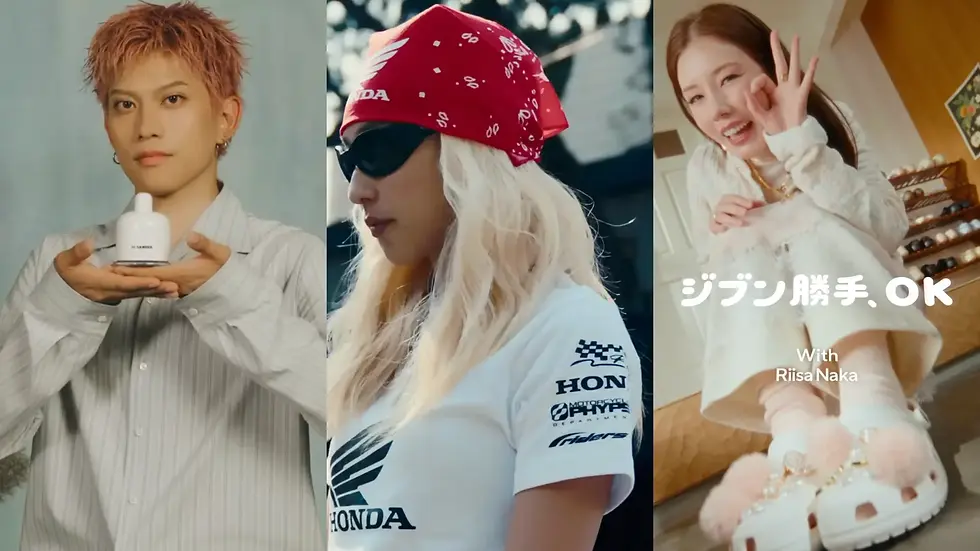
You can see the range of what "creator-led" now means in three recent campaigns. Crocs Japan turned its partnership with actress Riisa Naka into a serialized program — seasonal films under the "Jibun katte, OK" tagline running through 2025 and into 2026, with Naka styling Jibbitz charms her own way, mismatched left and right feet included — so the campaign reads as Naka being Naka, which is exactly why it works as advertising. Jil Sander took the same logic into the hardest category to sell through a screen, backing its fragrance push in Japan with creator Yamato Inoue: nobody can smell the product in a feed, so the audience isn't buying the scent description, they're buying the reviewer's taste. And Honda fronted its motorcycle apparel collection with street dancer KYOKA, folding the "Ride to Freedom" campaign into a long-form interview about her own path rather than draping product on a model.
4. LINE stays the retention engine
LINE reaches roughly 100 million people in Japan and more than 3 million businesses run LINE Official Accounts. Every discovery channel above eventually hands the customer to the same place. The brands that understand Japan treat LINE the way European brands treat email, except it works: an owned, permission-based line to the customer, with open rates email marketers stopped dreaming about years ago.
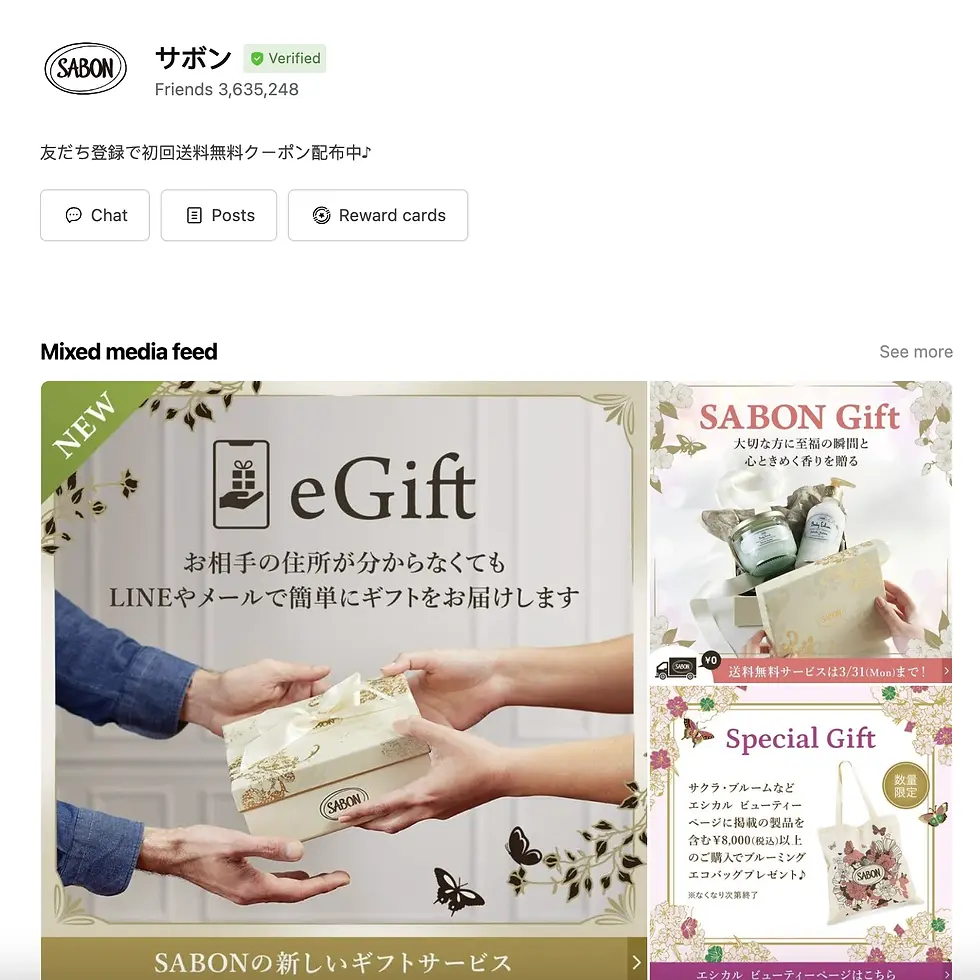
The body-care brand SABON is the pattern to study. It describes LINE as the cornerstone of its CRM strategy, linking membership data to customers’ LINE accounts so that segmentation runs on actual purchase history — one-to-one messages, not broadcast blasts (Source: LINE for Business case studies). Rich menus function as a persistent storefront inside the chat, coupons pull customers into physical stores, and step-automation sequences do the nurturing a sales associate would. Fashion retailers like Baroque Japan have run the same playbook to tie e-commerce and store visits together.
The trade-off nobody puts in the pitch deck: the block button is one tap away, and Japanese users use it without ceremony. Message costs also scale with volume, so an undisciplined broadcast strategy gets expensive and self-defeating at the same time. Every notification has to earn its interruption. The operational discipline — segment tightly, message less, make each message worth something — is the entire game.
5. GEO rises as a discovery layer
Japan gave ChatGPT a nickname. Chappie — チャッピー — was nominated for the country’s Buzzword of the Year in 2025, which tells you the tool crossed from tech circles into everyday vocabulary. When a foreign product gets a Japanese pet name, adoption has stopped being a forecast.

Generative engine optimization — GEO — is the response: structuring your content so AI answers cite you when a customer asks Chappie which serum to buy or which CRM handles Japanese invoicing. For brands entering Japan, one implication towers over the rest. AI engines answering Japanese-language questions draw overwhelmingly on Japanese-language sources. If your Japanese web footprint is a thin translated brochure, you are invisible at the exact moment a Japanese customer asks the question you exist to answer. Your Japanese-language authority content is now your AI answer footprint. And measurement here is still immature — citation tracking across AI platforms is early and noisy, so set expectations accordingly and treat 2026 GEO work as position-building, not performance marketing.
The homework is unglamorous: publish substantive Japanese-language pages that answer real questions directly, keep facts about your brand consistent everywhere they appear, and periodically ask the AI tools — in Japanese — what they say about you. I’ve started doing this for the categories we work in. The answers are occasionally flattering, occasionally alarming, and always worth knowing before your customer does.
CONCLUSION
Here is the pitch-room version. Read the five trends again, in a different order. GEO decides whether Japan discovers you when it asks a machine for advice. Vertical video earns the first three seconds of attention once you’re found. Creators convert that attention into borrowed trust. TikTok Shop turns trust into a first purchase without the customer ever leaving the feed. And LINE turns the first purchase into the second, the fifth, the twentieth.
Most brands will fund these as five separate line items, owned by five separate teams, measured on five separate dashboards. The ones that win Japan in 2026 will fund them as one journey — because that’s how the Japanese customer already experiences them. Budget for the journey, and the trends stop being trends. They become your funnel.
Frequently Asked Questions (FAQs)
Should we launch on TikTok Shop Japan this year?
Only narrowly. Don’t move your catalog; move one hero SKU that demos well in fifteen seconds and build live commerce and creator affiliate content around it. Home appliances and gadgets, beauty, and apparel took over 80% of launch-quarter GMV, so if your category sits outside those lanes, treat 2026 as a test year with test-sized expectations. KYOGOKU is the operation to study: short videos maintain daily reach, scheduled lives convert it, and clips from the lives feed the next round of discovery.
Is vertical video really overtaking television and horizontal YouTube in Japan?
The budget line has already answered. Japan’s video ad market is crossing ¥1 trillion in 2026 with vertical taking roughly 30% of smartphone ad spend, and TikTok’s Japanese adult audience hit 39.2 million, up nearly 50% year on year. The practical shift: 9:16 is the shape brand content is conceived in, not a repurposing decision — Asahi’s 8-episode mini-series with Gokko Club pulled over 80M views by programming the account like a small broadcaster.
How tightly should we script Japanese creator briefs?
Looser than your global template. Over-scripted posts read as forced to Japanese audiences and quietly suppress both engagement and conversion — a pattern I’ve watched repeat across markets, and Japan punishes it hardest. Brief the outcome and the claims you can legally support, then let the creator own the telling, the way Crocs did with Riisa Naka, Jil Sander with Yamato Inoue, and Honda with KYOKA.
What makes LINE different from just doing email marketing?
It works. LINE reaches roughly 100 million people, more than 3 million businesses run official accounts, and open rates sit where email marketers stopped dreaming years ago. SABON is the pattern: membership data linked to LINE accounts so segmentation runs on actual purchase history, rich menus as a persistent storefront, coupons pulling customers into stores. The trade-off nobody pitches: the block button is one tap away and message costs scale with volume, so segment tightly, message less, and make each message worth something.
What is GEO, and should we invest in it now?
Generative engine optimization is structuring your content so AI answers cite you when a customer asks which product to buy — and in Japan the adoption question is settled, given ChatGPT earned the nickname Chappie and a Buzzword of the Year nomination. The implication that towers over the rest: AI engines answering Japanese questions draw overwhelmingly on Japanese-language sources, so a thin translated brochure makes you invisible at the moment of the question. Measurement is still immature, so treat 2026 GEO work as position-building, not performance marketing.


