
Korea Marketing Strategy: 5 Proven Tips for Success

I’ve spent a good part of my career working on campaigns aimed at the Korean market, and there’s one thing I tell every brand before they start: Korea doesn’t reward the loudest spender. It rewards the brand that understands how culture moves there.
It’s a market with its own rhythm. A pop-up store can pull a two-hour queue. A three-second product shot in a drama can clear stock. Fans don’t just follow a celebrity — they organise, fund projects, and show up in numbers. That intensity is a gift, but only if you respect how it works.
None of the five approaches below are about budget. They’re about reading the room. These are the ones I keep coming back to, and I think they’re worth breaking down.
2026 Korea Marketing Strategy
Culture-sensitive marketing
1. Innovative retail and pop-ups

Korea — Seoul especially — has turned the pop-up store into an art form. Spend a weekend in a neighbourhood like Seongsu-dong and you’ll see it: temporary spaces built for a single brand moment, designed to be photographed, queued for, and talked about for the two or three weeks they exist.
Why does this land harder in Korea than almost anywhere else? Going somewhere physical is part of the social ritual. Visiting a pop-up isn’t a break from content — it is content. A few things I’ve learned make the difference between a busy pop-up and an empty one:
Work with influencers to bring the first wave. A pop-up is empty until it isn’t. I seed the opening days with creators who’ll actually show up, post, and signal that this is worth someone’s Saturday. Their early visit creates the queue, and the queue creates everyone else’s curiosity.
Make it immersive, not just decorated. The best spaces give people something to do — a room to move through, a sensory moment, a reason to stay longer than a photo takes. People remember what they experienced, not what they looked at.
Add a personalisation activity. Letting visitors customize something — engrave it, mix it, choose it — turns a visit into a small story they own. They leave with a thing that’s genuinely theirs, and they post it precisely because it’s theirs.
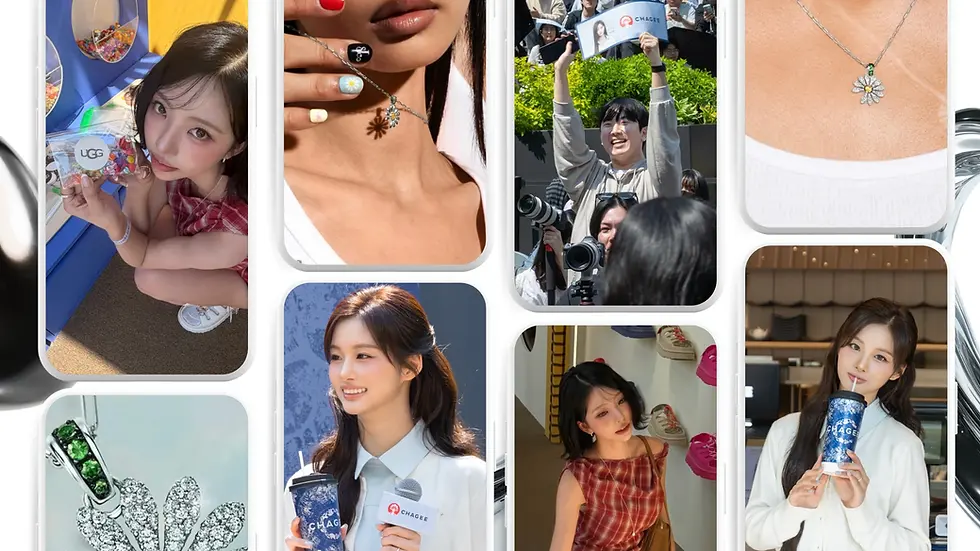
A recent campaign gets all three of these right at once. For Seoul Jazz Festival 2026, UGG Korea built its pop-up inside the festival rather than off to the side somewhere. They brought influencers in early — reality star Kim Go-eun among them — to visit the booth and share photo carousels of what they did there. That’s the first-wave seeding I mean: a familiar face turns the booth into part of the event instead of a sales stand bolted onto it. And inside, visitors could pull together a festival look and customize their UGGs with charms, bandanas, and laces. You don’t walk out with a generic product — you walk out with the pair you made, and that’s the pair people photograph and post for you.
2. K-idol co-creation

Signing a K-idol as a model is easy. Co-creating with one is where the real value sits. There’s a difference between a celebrity holding your product and a celebrity helping shape it. When an idol is involved in choosing a colourway, naming an edition, or designing a small detail, two things happen at once: the product gets better tailored to the fandom, and the fandom treats it as theirs to support.
Given the choice, I’d take one genuine collaboration — an idol-designed edition, a co-developed product — over ten flat endorsement posts. Fans can tell the difference between something an artist built and something an artist was paid to hold, and they reward the real thing.
Jacob & Co’s collaboration with PEACEMINUSONE, G-Dragon’s own label, is a clear example of the difference. This wasn’t G-Dragon photographed wearing a watch — it was a limited-edition jewellery line he actually co-designed, built around his Daisy, the flower motif his fans already read as shorthand for him. That detail is the whole point. When the signature element of the product is something the fandom personally associates with the artist, the collaboration isn’t borrowing his fame — it’s turning a symbol the fans already own into something they can wear. They don’t see an endorsement; they see their artist’s world made real.
3. Subtle influencer marketing
Social media is enormous in Korea, and the audience there has a finely tuned radar for ads. The mistake I see most often is treating a creator like a billboard — drop the product in, read the script, done. It doesn’t work. Viewers will scroll straight to the comments and call it out.
What works is the subtle tie-in. The product shows up inside content the creator would have made anyway — a vlog, a what’s-in-my-bag, a cooking video, a morning routine. It’s there, it’s mentioned honestly, but it isn’t the reason the video exists. That’s the version viewers forgive, and honestly, the version they trust.
So pick creators whose normal content already lives near your product. Done right, the integration feels like a coincidence, not a contract.
Dex’s video with the Republic of Korea Coast Guard shows this done well. The video isn’t about skincare at all — Dex spends a day inside the Coast Guard’s routine, learning how they run operations, enforce the law against illegal fishing, and why something as ordinary as a life jacket matters, and he comes away with genuine respect for the work and the sacrifice behind it.
The men’s skincare brand OBgE is the tie-in partner, but it sits inside the content rather than on top of it. The result tells you it landed: the video passed 1.3 million views, and the comments praised Dex and the respectful way the film treated Korea’s maritime police — not the brand. When viewers are that busy talking about the story, the integration has already done its job.
4. Culture-sensitive Marketing
A concept that tests beautifully in New York or Jakarta can be clever, or at worst neutral, almost everywhere else and still detonate in Korea, because Korean audiences carry a shared history and a set of sensitivities a global creative team simply won’t feel in the room.
Korean consumers reward brands that feel respectful, well-made, and aware of the moment. They punish anything careless with the things they hold close — their history, their national memory, their dignity.
The clearest recent warning is Starbucks Korea’s “Tank Day.” In May 2026 the brand ran a promotion for its Tank Series travel tumblers — and it landed on 18 May, the anniversary of the Gwangju Democratization Movement, when the 1980 military crackdown killed pro-democracy protesters. In most markets, a tank-themed tumbler launch is harmless fun. In Korea, tanks on that date point straight at one of the most painful chapters in the country’s modern history. The promotion was read as making light of the victims, and the backlash was immediate and enormous.
The lesson isn’t simply “be careful.” It’s that local context isn’t a translation step you bolt on at the end — it’s the foundation you build on. The brands that win in Korea treat a local reviewer who knows the calendar, the history, and the mood as the most important person in the approval chain, not the last one to sign off. Everything else on this list only works if you’ve earned the right to be in the conversation, and a single careless date can take that away.
5. K-pop Idol Fandom marketing

This is the one I’d put at the centre of any Korea marketing strategy. Korean fandoms are organised in a way that’s hard to overstate. They run their own communities, coordinate quickly, fund projects, and turn out in real numbers. If a brand earns their goodwill, it gains a marketing force no media budget can buy.
But you have to give the fandom something real in return. Fan meets, branded concerts, exclusive events — moments that exist for the fans, not just around them. When a brand supports something fans genuinely wanted, it stops being a sponsor and becomes part of the memory.
The mistake is treating a fandom as an audience to broadcast at. They’re a community, and you’re a guest in it. Be generous, be respectful, be consistent — and they’ll carry you further than any ad spend would.
CHAGEE did a clean version of this when it opened its first flagship store in Seoul. Instead of a standard ribbon-cutting, the brand invited Sullyoon and turned the opening into a fan meeting for her fans. Think about what that does. The people queuing aren’t there for a tea brand — they’re there for an afternoon with someone they follow, and CHAGEE is the reason that afternoon exists. The brand stops being a backdrop and becomes the host of a memory the fandom wanted anyway. That’s the trade I keep coming back to: give the fandom something real, and they’ll fold you into it.
CONCLUSION
Look at these five together and a pattern shows up. Korean marketing rewards brands that take part in culture instead of buying the space next to it.
Pop-ups work because they’re experiences, not displays.
Co-creation works because it’s genuine, not transactional.
Influencer marketing works when it’s subtle, not staged.
Cultural fit isn’t a final check — it’s the foundation everything else stands on.
Fandom works when you give first.
None of this needs the biggest budget. It needs attention — to how fans behave, to what feels real, and to when a moment is actually happening. The brands that win in Korea are the ones treating the audience as people whose time and trust have to be earned. In my experience, that’s the whole strategy.
Frequently Asked Questions
Why is understanding South Korean culture important for marketing?
Grasping South Korean culture helps brands align messaging with local values, such as the importance of reputation ("face"), innovation, and quality. This understanding fosters trust and increases the effectiveness of marketing campaigns aimed at Korean consumers.
How essential is localization of content when marketing in Korea?
Localization is crucial—content should resonate with Korean consumers in language, design, and cultural relevance. Brands that localize their campaigns and materials see stronger engagement and higher returns on their marketing investment.
Can small businesses use influencer marketing effectively in South Korea?
Yes, micro- and nano-influencers are particularly valuable for small businesses because they offer high engagement, authenticity, and lower partnership fees. Collaborating with them can drive impactful, cost-effective outreach.
Is it necessary to partner with a local Korean agency or distributor?
Partnering with a local agency is highly recommended due to their insights into market trends, business etiquette, regulatory compliance, and existing networks. This can improve market entry prospects and help avoid common pitfalls.
