
Digital Marketing in Korea: A How-to Guide
- Arthur S.

- Jun 10
- 8 min read

If you've been running campaigns in Korea for any length of time, you know this market doesn't behave like the global playbooks assume. Naver and Kakao set the rules. YouTube eats roughly 40 hours of every Korean's month. Coupang, Olive Young, Musinsa, and Zigzag have trained shoppers to expect content and commerce in the same breath. So when the big 2026 trends land here, they land differently — and the teams that adapt to the local version win.
Here's what we're seeing in the field, and what I'd tell anyone planning Korean campaigns for the year ahead.
Digital Marketing in Korea: A How-to Guide
1. Creator-Based Ads: Stop Buying Media, Start Casting Creators
The biggest mindset shift on our side of the desk: we've stopped asking "How do we split the budget across YouTube, Instagram, and TikTok?" and started asking "Which creators should carry this campaign — and which of their posts deserve paid spend?"
The workflow that's winning in Korea right now looks like this: seed product to a spread of creators — usually smaller, niche ones — let them produce native content, watch what performs organically, then amplify only the proven winners as paid. Meta's Partnership Ads and TikTok's Spark Ads make this clean, because you're running the creator's own post, with their handle and credibility intact, as a media buy. One asset earns its keep twice.
What makes this work locally is that the platforms are building the rails for it.
Naver Shopping Connect lets creators on blogs, Clip, and Chiji link content straight to purchase, so a brand can build a UGC-driven sales path without a single banner.
Zigzag's Creator Lounge pulled in over 23,000 creators during its pilot and is on track to push past ₩10B in annual transactions — and sellers can now talk to creators directly to set up collabs.
The infrastructure is here; most brands just aren't using it yet.
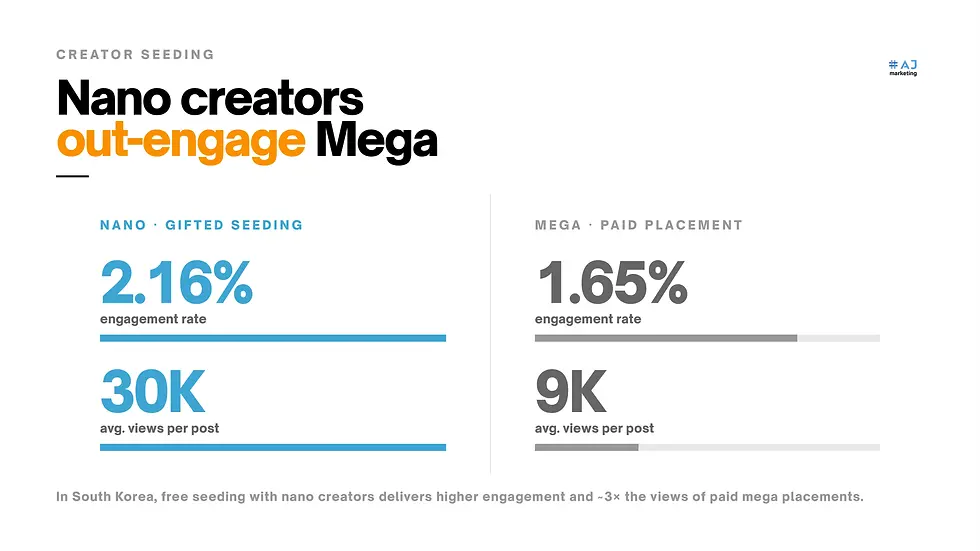
And the numbers back the smaller-is-better instinct we keep seeing in performance reports: micro creators out-convert mega ones on click-through, at a fraction of the cost per follower. Free product seeding to nano creators often beats paid seeding on both engagement and views.
From the field: Build a category roster and seed broadly. A great influencer campaign example is how Insta360 partners with multiple creators in multiple categories: tech unboxings, beauty & lifestyle, digital creators, and household creators, to promote the Insta360 x Hello Kitty edition.

2. AI Producing: The Production Line Moves to AI, the Brief Stays With You
Content demand here is relentless — Naver, Kakao, YouTube, and every commerce app want fresh creative constantly — while teams and budgets aren't growing to match. That gap is exactly what AI Producing fills: AI does the making, people do the planning, directing, and quality control.
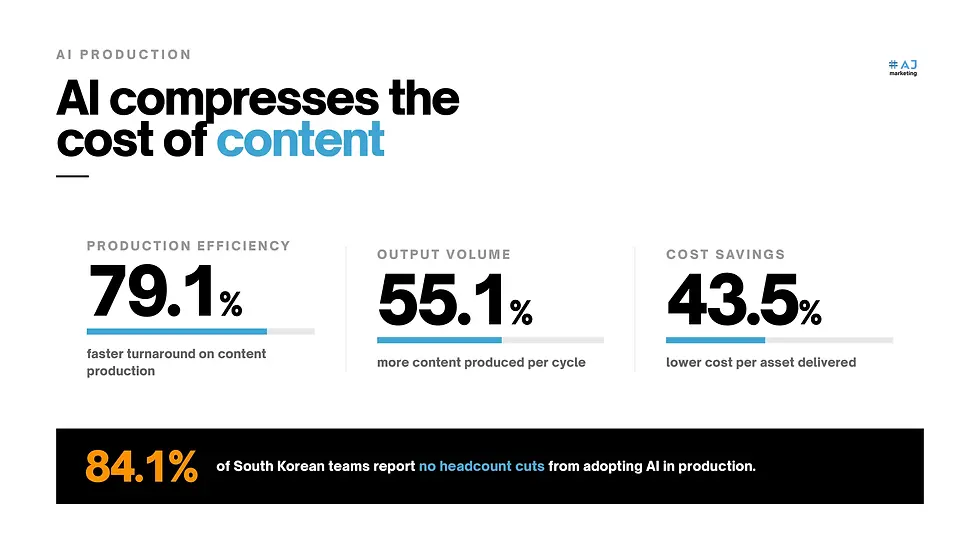
The standout Korean case is Yanadoo. Their short-form featuring an Ai-generated talking dog gains high views and engagement. Subscribers roughly tripled from 200K to 600K in about six weeks. The kicker: built largely with Veo 3, production cost and time dropped to around 1% of the old way.
From the field: Start with your highest-volume, most repetitive formats — product imagery, performance social cuts — not your hero brand film.
3. The Peacock Strategy: Standing Out When Naver and Kakao Are Wallpaper
Korean users have seen the same ad placements in the same spots for years. The result is textbook banner blindness — the vast majority of users register an ad and reflexively filter it out. On Naver and Kakao especially, the standard units have become wallpaper.

The answer is what we're calling the Peacock Strategy: make the ad impossible to skip by changing its size, position, or format. It runs two ways, and Korea is a live showcase for both.
Format Scale-up — winning by going big.
Brands are buying placements far larger than the old standard units — full-screen takeovers that fill an entire homepage, oversized feed ads, and giant outdoor screens that dominate a whole building or station wall. The logic is that a placement big enough to fill someone's field of vision is much harder to scroll past or ignore. And it works: these large-format placements hold attention significantly longer and leave people with a stronger, more positive impression of the brand.
Format Innovation — winning by being unexpected.
The other way to break through is novelty. People ignore ads partly because they all look the same and sit in the same predictable spots. So instead of going bigger, this approach changes the format itself — rearranging where elements sit, varying the design, or placing ads in moments and spaces that were never used for advertising before. By showing up in a fresh way, or at a moment that actually fits what the user is doing, the ad feels less like an ad and earns a second look.
From the field: Audit every placement against one question: "Would I scroll past this?" Then reserve a slice of every campaign budget for one genuinely scale-driven or rule-breaking execution, rather than spreading everything thin across safe standard units.
4. GEO: Getting Recommended Inside the AI's Answer
Korean discovery behavior is shifting fast. Naver and YouTube still lead, but both slipped year-over-year in the "where do I go to find information" rankings — while generative AI services surged, with ChatGPT climbing into the top tier and AI use for discovery jumping triple digits. A large majority of people who get an AI recommendation end up buying based on it. The search box is quietly becoming a chat box.

That makes Generative Engine Optimization (GEO) a real discipline now. The job is no longer just ranking on Naver — it's getting your brand named and recommended inside the AI's answer. And with ChatGPT adding shopping research, buy buttons, and instant checkout, that answer is becoming the storefront.
The practical work, based on what AI actually reads:
Text and structure — clear headings, FAQ/Q&A sections, schema markup, descriptive alt text. The classic Korean mistake is burying every product detail inside a pretty image the model can't read. Pull the key facts out into text.
Context — frame content as problem-solving ("how to fix X"), write for the specific long-tail questions people actually ask, and prove experience and expertise (Google's E-E-A-T).
Multimodal and reviews — accurate captions on your YouTube content, keyworded chapters, on-screen text held 3–5 seconds so the model can read it, and a healthy base of authentic reviews on Naver, communities, and shopping malls. AI listens to what's said in your videos and what others say about you.
From the field: Treat your owned content as training data. Caption your videos, structure your detail pages for machines as well as humans, and seed credible reviews and mentions. Also start setting your V-GEO foundation — Instagram posts are now eligible for search-engine exposure, so profiles, captions, hashtags, and alt text matter more than they did six months ago.
5. Content-Friendly UX: When the Content Is the Storefront
Korean apps are redesigning themselves around content — short-form and feeds pushed to the front, passive scrolling turned into discovery, exploration, and purchase without anyone ever searching.

Commerce led the way, and the local examples are everywhere:
W Concept put a "Play" tab dead-center in the main bar — watch product-linked short-form, buy instantly — and saw its top ~70 brands average a 40% sales lift in a single month.
Daiso Mall added a "Today's Discovery" tab
Olive Young moved a feed-style "Discovery" tab to the center with product links under each clip.
Naver Plus Store swaps search for a discovery feed that flows straight into checkout.
Alwayz uses a content tab plus reward mechanics to drive dwell time.
The more telling signal is that non-commerce apps are following. Naver Maps now surfaces recommended places through swipeable video that links to the spot or product. KakaoTalk launched a "Now" tab fusing open chat and short-form purely to grow engagement — and reported dwell time up ~10% versus its three-month average.
Under all of it, the once-separate functions — search, recommendation, product detail, purchase, review — are merging into one content-led flow. The lesson for Korea is blunt: the path from "I love this" to "I bought it" has to be frictionless, or the whole thing collapses.
From the field: Stop treating content and conversion as separate stages with separate owners. Design the discovery, the understanding, and the buy moment to live inside one continuous content experience — and pressure-test the checkout path, because that's where Korean conversion quietly leaks.
Conclusion
Pull back and the same force runs through all five: when it comes to digital marketing in Korea, content has become the center of gravity — the asset creators supply, the thing AI reads to recommend to you, and the interface itself. Creators and AI produce it, the Peacock plays make it visible, GEO makes it discoverable to machines, and content-first UX turns it into a sale.
The teams that treat these as one connected system — rather than five line items — are the ones who'll spend 2026 ahead of everyone still planning campaigns the way they worked in 2024. In a market as fast and as platform-driven as Korea's, that gap compounds quickly.
Frequently Asked Questions
Should I still split my budget evenly across YouTube, Instagram, and TikTok?
That's the old question. The one worth asking now is which creators should carry the campaign — then put paid spend behind the posts that already prove themselves organically. Seed product broadly to smaller, niche creators, watch what performs, and amplify only the winners using Meta Partnership Ads or TikTok Spark Ads. You're buying the creator's own post, handle and credibility intact, so one asset earns its keep twice.
Why smaller creators over the big names?
Because the numbers keep pointing the same way: micro creators out-convert mega ones on click-through, at a fraction of the cost per follower. Free product seeding to nano creators often beats paid seeding on both engagement and views. The reach feels smaller, but the conversion math is better.
Is AI-generated content actually working in Korea, or is it hype?
It's working when it's pointed at the right job. The clearest case is Yanadoo — their short-form with an AI-generated talking dog tripled subscribers from 200K to 600K in about six weeks, built largely with Veo 3, at roughly 1% of the old production cost and time. The catch: AI does the making, you still do the planning, directing, and quality control. Start with your highest-volume, most repetitive formats, not your hero brand film.
What's the "Peacock Strategy" and why do I need one?
On Naver and Kakao, the standard ad units have become wallpaper — people register them and reflexively filter them out. The Peacock Strategy is making an ad impossible to skip by changing its size, position, or format. Either go big (full-screen takeovers, oversized feed ads, giant outdoor screens) or go unexpected (new placements, fresh formats, moments that actually fit what the user is doing). Reserve a slice of every budget for one genuinely bold execution instead of spreading everything thin across safe units.
What is GEO, and is it worth investing in yet?
GEO — Generative Engine Optimization — is getting your brand named and recommended inside an AI's answer, not just ranked on Naver. It matters now because Korean discovery is shifting fast: generative AI use for discovery jumped triple digits, and a large majority of people who get an AI recommendation buy based on it. The practical work is unglamorous — pull product details out of pretty images into readable text, structure pages with clear headings and FAQs, caption your videos, and seed authentic reviews. Treat your owned content as training data.


