Advertising in South Korea: Full Guide 2026

South Korea is one of the most demanding advertising markets I've ever worked in, and I mean that as a compliment. People here are online almost constantly, they research before they spend, and they can smell a lazy campaign from a mile away. When a whole country is that connected and that discerning, you can't coast on reach alone.
Here's the thing I keep telling brands walking in for the first time: the playbook that works in your home market won't automatically transfer. Korea has its own platforms, its own rhythms, and its own idea of what feels trustworthy. So instead of a generic checklist, this is the stuff I'd actually sit down and explain to a client over coffee — five things shaping how brands advertise here in 2026.
In this guide
1. What You Need to Know About Korea Consumers
Before you spend a single won on media, you have to understand who you're talking to. Korean consumers are not a monolith, but a few traits show up again and again, and they change how a campaign should be built.
They do their homework
Koreans research. A lot. Before buying, most people will check reviews, watch a video or two, and read what other shoppers have said — often across several platforms in one sitting. This means your ad is rarely the last touchpoint. It's the thing that sends someone off to investigate. If what they find doesn't back up your message, you've lost them. The brands that win here treat their reviews, blog mentions, and YouTube footprint as part of the campaign, not an afterthought.
Brand-conscious, but not blindly loyal
Koreans care deeply about brands and design, and they'll pay a premium for something that looks and feels well made. But that doesn't mean they stick with you out of habit. They're genuinely open to switching, especially when someone they trust — an artist, a creator, a friend — points them somewhere new. That's a warning and an opportunity. You can lose share faster than you'd like, but you can also break in faster than you'd expect.
The rise of living alone
One of the biggest shifts under the surface is the solo economy. Single-person households now make up somewhere between 36% and 42% of all homes depending on which agency you read — the Ministry of the Interior puts it at roughly 10 million households (Source: Seoulz, 2026). This reshapes demand in concrete ways: smaller portions, single-serve packaging, subscriptions, delivery, and products designed for a life lived solo. If your messaging still assumes a family of four around the dinner table, a huge slice of the market quietly tunes out.
Spending on how things feel
There's a phrase locals use — the “feelconomy” — to describe how much Koreans now spend on emotion and experience rather than pure function. Pop-up stores, limited drops, and small moments of delight do real commercial work here. People will queue, pay more, and share online when something makes them feel something. Keep that in mind: in Korea, the emotional payoff of a product is often as important as what it does.
The brand I always point to here is TAMBURINS, the sister brand of eyewear label GENTLE MONSTER. They've turned this principle into a craft. With every drop, they build pop-ups and elevated retail spaces that pull customers right into the world of the product — so you're not just buying a hand cream, you're stepping into an experience worth photographing and sharing. That's the feelconomy working exactly as intended.

2. Social Media Channel Trends
People ask me which platform to be on in Korea, and the honest answer is: it depends what you want the platform to do. Each one plays a distinct role, and trying to use them interchangeably is how budgets get wasted. Here's how I think about the main four.
KakaoTalk — the one everyone is on
KakaoTalk is the backbone of daily life in Korea, with around 49.1 million monthly active users — about 95% of the population (Source: DataReportal, 2026). It's a messaging app first, so it isn't where you go viral. It's where you build a relationship. Brands use Kakao channels to talk directly to customers, push coupons and updates, and — this is the underrated part — tap into Korea's gifting culture, where people send small digital gifts to friends right inside the chat. Think of Kakao as your CRM and conversion layer more than your awareness layer.
YouTube — the trust engine
Around 85% of Koreans use YouTube, across every age group, and many treat it as a search engine and a news source as much as entertainment. This is where depth lives. Reviews, tutorials, unboxings, long explainers, and creator collaborations all do their best work here. If someone is seriously considering your product, there's a good chance they'll end up watching a YouTube creator’s video about it before deciding. Make sure the video they find is one you'd want them to see.
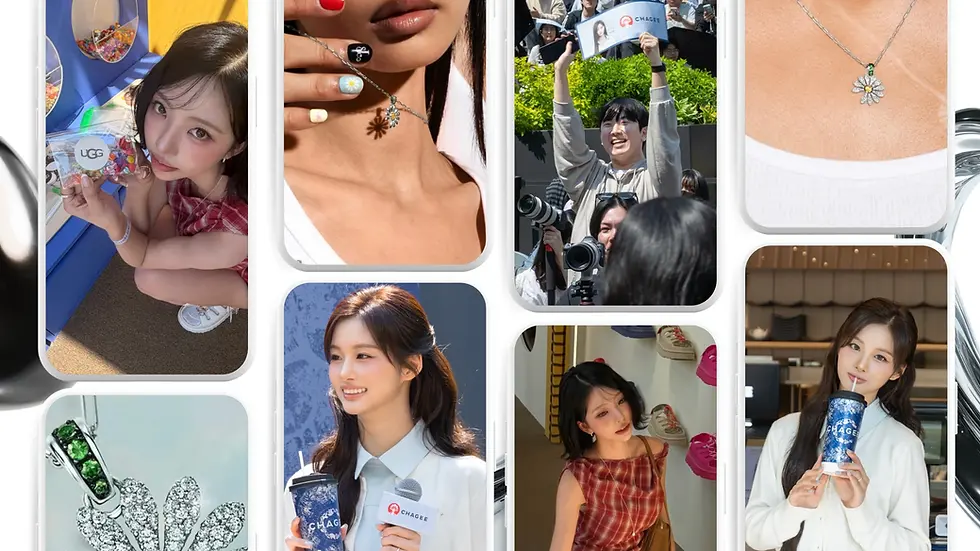
What's worth understanding is how Korean viewers actually want product placement to feel. They gravitate toward subtle integrations that don't hard-sell and instead weave naturally into the content. SEULGI's Bali travel vlog in partnership with Samsonite is a great example — it's really just her travel outfits, good local food, and an easygoing trip with her friend Sujin, with the luggage simply along for the ride. It pulled over 900K views, and the comments were full of people saying how much they loved her relaxed, unplanned vacation style. The brand won by staying in the background.
Instagram — the visual storefront
Instagram is growing fast, especially among people in their 20s, 30s, and 40s, where it's often the third most-used platform after Kakao and YouTube. It's where aesthetics matter most — product launches, lifestyle content, Reels, and the kind of polished imagery that makes something feel desirable. If your brand lives or dies on how it looks, this is your stage.
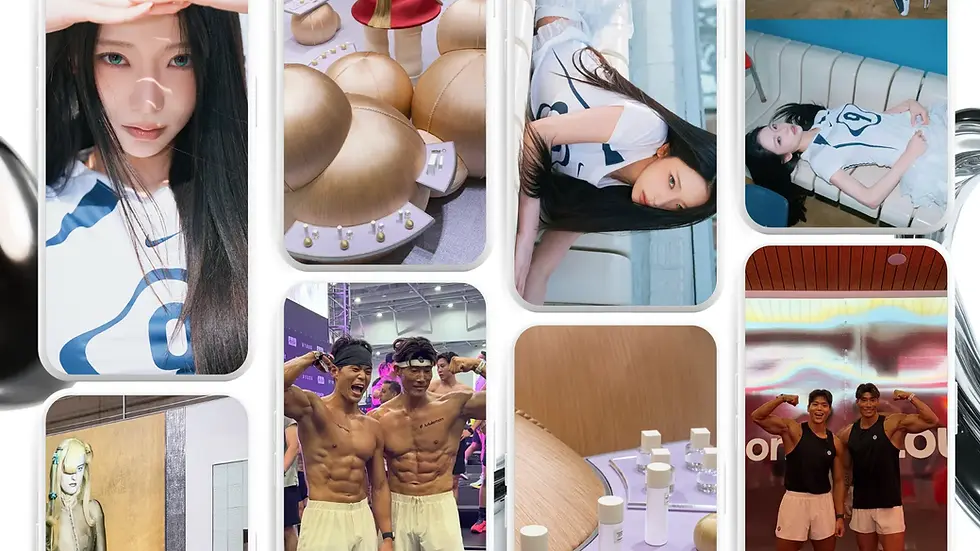
This is also where mega-KOLs and reality-show stars really thrive. Look at Yoonseo's paid post for Nike Seoul: the visuals are genuinely professional-grade, shot with a level of polish you'd expect from a full campaign rather than a single Instagram placement. That's the bar on this platform — on Instagram, the production quality is the message.

Naver — where discovery starts
Don't make the mistake of treating Korea like a Google-only market. Naver is the home base for search, blogs, and community cafes, and a huge amount of product discovery and review-reading happens there. Showing up well on Naver — through blog content, search presence, and genuine reviews — is often what tips a curious shopper into a confident one. TikTok is rising too, particularly with younger audiences, but it's still smaller than the big four.
3. Local Brands Are Looking for Celebrity Content
If there's one thing Korean marketing is famous for, it's the power of a face. Celebrity endorsement has always mattered here, but what's changed recently is how brands use these people — and how big they're willing to go.
It used to be enough to put a star in a TV commercial and call it a day. Not anymore. Brands increasingly want celebrities and mega-KOLs to make content the way an influencer would — showing up on their own Instagram, in branded YouTube episodes, on Weverse, and in short clips that feel native to the platform. The personal brand of the individual has become the asset. Audiences don't just want to see a famous person holding your product; they want to feel like that person actually lives with it.
Casetify's collaboration with SOMI captures this shift perfectly. Rather than a straight product plug, the video follows SOMI working a shift at her parents' new restaurant, promoting it while juggling her packed schedule, flexing her marketing instincts, and taking the promo photos herself. It pulled in over 190K views, with comments full of people delighted to see her actually working at the restaurant in person. The product is there throughout, but what people came for was the personality — and that's exactly the point.

4. Animation Marketing is Trending Up
This is the trend I've been watching most closely, because it's moving fast. Short, fun, animated videos — increasingly made with AI — are becoming a real part of the Korean brand toolkit, and it makes a lot of sense once you think about it.
Korea already has a deep love of brand characters and mascots — anyone who's used KakaoTalk knows the Kakao Friends characters, which have their own stores. So a playful animated style doesn't feel foreign here; it feels familiar. Animation also gives you total control over tone, it's endlessly cute and shareable, and it sidesteps the cost and scheduling headaches of a live shoot. For a quick, scroll-stopping clip on Instagram or YouTube, a 15-second animation often outperforms something far more expensive.
The reason this is suddenly everywhere is AI. Industry estimates suggest around 75% of marketing videos in 2026 are AI-generated or AI-assisted, and AI video tools crossed roughly US$700 million in market value in 2025 (Source: Design Force / Wyzowl, 2026). For a brand, that means you can produce a whole batch of short animated videos, test which ones land, and keep the winners — all at a fraction of what it used to cost. Small teams can now make a lot of content quickly, and platform algorithms tend to reward exactly this kind of short-form motion.
Here's my honest caveat: audiences have gotten good at spotting lazy AI. The animations that work still have a clear creative idea, a consistent character or look, and a human directing the story — AI just handles the heavy lifting. Use it to move faster, not to skip the thinking. The moment a video feels like it was generated rather than made, the charm evaporates.
5. Brand Communication Aligns With Trending Consumer Interest
The best campaigns I've seen in Korea don't try to drag attention toward the brand. They meet people where their attention already is. Right now, the clearest example of that is wellness — but the principle is bigger than any one topic.
Wellness is the conversation of the moment
Health and wellness has become one of Korea's defining consumer interests. The market reached roughly US$74 billion in 2025 and is projected to keep growing for the next decade (Source: Market Research Future, 2026). Koreans are leaning into preventive health, functional foods, supplements, fitness, mental wellbeing, and longevity. There's even a local label for it — “K-wellness” — blending herbal tradition with sleek, tech-enabled self-care, much the way K-beauty did before it.
Beauty and wellness are blurring together
One specific shift worth knowing: the line between beauty and health has basically dissolved. Ingestible-meets-topical products, collagen and probiotics in everything, adaptogens for stress, supplements aimed at energy and mood — these are flying off shelves, especially with younger shoppers who see looking good and feeling good as the same project. If you're in beauty, food, or even tech, there's likely a credible wellness angle you can lean into.
The real lesson: move with the conversation
Don't just bolt wellness onto a brand because it's trendy — Koreans will see through that instantly. The deeper point is to stay genuinely close to what people care about right now, whether that's wellness, living solo, sustainability, or emotional wellbeing, and let your communication ride that interest honestly. Timing and relevance can be the whole strategy. The brands that pay attention to the cultural conversation, and join it early and sincerely, almost always outperform the ones shouting about themselves.
Lululemon is doing this well right now. Instead of talking about itself, it's leaning hard into fitness and riding the Hyrox craze sweeping Korea, bringing on fitness star Amotti as brand ambassador to meet that energy where it already lives. The brand isn't manufacturing interest — it's joining a conversation that's already happening.

Final Thoughts
None of the brands doing well in Korea got there by accident. When I look across the market, the same patterns keep showing up:
Understand the consumer first — solo living, careful research, and emotional spending change everything.
Match the platform to the job — Kakao to nurture, YouTube to convince, Instagram to attract, Naver to be discovered.
Use celebrity and creator content as living, native storytelling, not a one-off TV spot.
Lean into short, fun, AI-assisted animation — but keep a human steering it.
Align with what people already care about, and join the conversation honestly and early.
Korea rewards brands that pay attention. Not the biggest budgets — the ones that listen closest, move at the right moment, and feel like they actually belong in the conversation. Get that right, and this becomes one of the most rewarding markets you'll ever work in.
Frequently Asked Questions
Why should I advertise my business in South Korea?
Korea is one of the most connected and tech-savvy markets in the world, with near-total internet penetration and a population that actively researches and shops online. Consumer confidence is strong heading into 2026, and shoppers are open to new brands when the fit feels right — which makes it a genuine growth opportunity for businesses willing to do it properly.
Which social media platforms matter most in South Korea?
KakaoTalk, YouTube, Instagram, and Naver are the core four. KakaoTalk is best for direct customer relationships and gifting, YouTube for trust-building and depth, Instagram for visual and lifestyle content, and Naver for search and product discovery. TikTok is growing but still smaller than the big four.
Do I need a celebrity to advertise in Korea?
Not necessarily, but celebrity and KOL content carries real weight here. Many brands pair a high-profile ambassador for awareness with mid-tier creators (roughly 100K to 1M followers) for trust and conversion. What matters most is fit and authentic, native-feeling content — not just fame.
Is AI animation actually worth using?
For short-form social content, yes — it's fast, affordable, shareable, and suits Korea's love of brand characters. The catch is that audiences notice lazy AI, so the strongest results still come from clear creative direction and a consistent look, with AI handling production rather than the thinking.
How important is local knowledge when entering the Korean market?
Very. Platforms, cultural norms, and consumer expectations differ enough that a foreign playbook rarely transfers cleanly. Working with local partners or a Korea-focused agency, and using Korean-language content and reviews, makes a real difference to how trustworthy and relevant your brand feels.